Showing posts with label Cumana. Show all posts

Monday, May 17, 2010

CATCH UP!

LET’S DO SOME CATCHING UP SHALL WE?


HOLY WEEK WITH THE NEW NATIONAL CHILDREN’S ORCHESTRA

I promised a surprise in my last blog, which was written in Venezuela, so here it is:

In an awesome example of how far El Sistema has come in the last 35 years, they are now putting out a fourth national orchestra. Just to be clear, there are presently 3 El Sistema orchestras that get their musicians from all over the country:

1) Simon Bolivar Youth Orchestra A: An excellent orchestra of El Sistema veterans and graduates that performs mainly in Venezuela,

2) Simon Bolivar Youth Orchestra B: They play all over the world and we’ve seen them on YouTube. They actually started out as a national children’s orchestra (later changing their name to the Simon Bolivar Youth Orchestra) and slowly developed into the phenomenon they are today, with Gustavo Dudamel winning the Mahler conducting competition acting as a catalyst for the international El Sistema boom. Many of the players in Simon Bolivar “B” have been playing together since they were 10 or 11 years old. Indeed Dudamel himself was a violinist in the orchestra when he was growing up, and got one of his first conducting opportunities when a conductor was late to rehearsal and he voluntarily stepped in to conduct.

3) Teresa Careno Youth Orchestra: a national orchestra of high school students. If you’ve seen Abreu’s TED Prize video, you’ve seen this marvelous orchestra.

And now, there’s a new, fourth orchestra: the National Children’s Orchestra, comprised of kids 15 years old and under. Their first week of rehearsals was held during Holy Week in Caracas and the Abreu Fellows were graciously invited to watch. We’re not allowed to show any videos or pictures of the orchestra yet so I’ll attempt to describe the scene.

The rehearsals are complete madness. Happening simultaneously we had: 358 kids playing Mahler’s 1st symphony. 20 basses. 18 bassoons. A trillion violins. A coach for every instrument section. Too many apprentice conductors. And running the rehearsal is Jose Antonio Abreu himself, sitting comfortably behind the apprentice conductor sipping ice tea. Yes, that’s correct, the 71-year-old founder of El Sistema still runs rehearsals. This is his baby, after all.

During the rehearsals the kids are told to sit tight because there’s a surprise for them. A few minutes later in walks Gustavo Dudamel. The kids go nuts. I almost start screaming myself but then remember that I am a guest and seated at the front of the room where I can be seen.

They play through Mahler 1, 4th movement for Gustavo. Then the teachers ask him if he has any comments and if he’d maybe like to conduct. The crowd goes nuts again. Gustavo can’t say no. Off comes the watch and out of the pocket the cell phone goes. He looks for a baton and within a few seconds there are a dozen batons in his face. He picks one. It doesn’t feel right. He picks another and steps onto the podium. He turns the score to the beginning of the 4th movement. He then proceeds to conduct the whole movement and never turns a page in the score. The kids play amazingly, like it’s their last day on earth. He then rehearses the orchestra, still without ever using the score, as the kids hang on to his every last word. Without question Dudamel is a rock star. The plan for this new children’s orchestra is for them to go on tour with a world-renowned conductor who I’m not allowed to mention, yet. Watch out.

Oh, I forgot to mention the six (maybe seven)-year old simply known as “Volcan.” He’s a percussionist who successfully auditioned for a spot in the children’s orchestra. In his spare time he conducts (and you should be accustomed to these stories by now), so of course, he was put on the podium for Dudamel, Abreu and the Fellows to watch him conduct, from memory, the 358 musicians in Venezuela’s national anthem. I have the video of this if you don’t believe me, I’m just not allowed to show it to you.

With "Volcan" and Luis Cordova, bassoonist with the Simon Bolivar Youth Orchestra "B"


CUMANA

Cumana

I need to mention my week with Stan in Cumana, a beach town on the coast of eastern Venezuela. The nucleo there was preparing for a concert to be performed in Caracas. Among the repertoire was Shostakovich’s 10th symphony, a staple of all the El Sistema orchestras. I should mention that they were also preparing some great Latin American repertoire. I’ve said it before and I’ll say it again: I believe a symphony orchestra in this day and age is not limited to Mozart and Beethoven. It is an instrument that can play any kind of music with any kind of artist. Indeed many North American orchestras play various genres throughout their seasons and many of my highly trained colleagues from my school days play with hip-hop artists like Kanye West and Common. I hope to see this trend continue alongside the Tchaikovskys, Bachs and Brahms.

One thing I loved about Cumana was that people wear shorts. Being close to the beach, flip flops and surfer shorts were the norm. This was good for me because otherwise I would have stood out as a tourist with my khaki shorts and high white socks (I forgot to pack short socks).

Cumana, fitting in with my high socks and shorts.

The students at the nucleo promised to take me to the beach but of course that never happened because of the intensive concert preparation. Instead of beaching it on the coast on Sunday morning, I spent it coaching bassoonists from the entire state of Sucre (where Cumana is). I can’t complain, I had a great time. I also gave away the rest of the bassoon materials I brought down to Venezuela courtesy of Sue Heineman and Matthew Ruggiero.

In Cumana with the bassoonists from the State of Sucre Orchestra

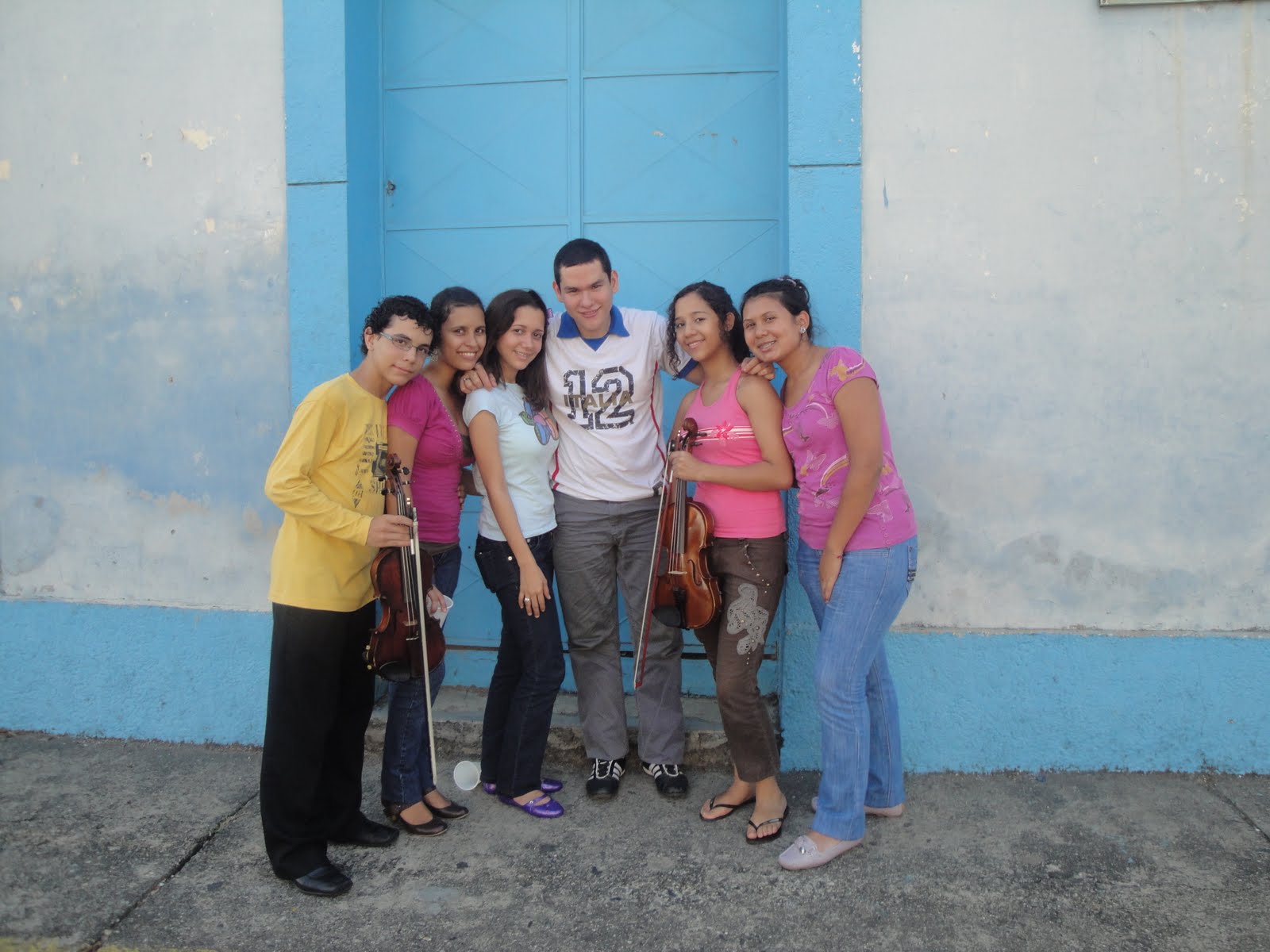
I should mention the dedication to the nucleo that many former music students demonstrate, and not just in lip service. Many of them have jobs, engineers and accountants for example but continue to teach at the nucleo on a weekly basis. Abreu talks about music affecting the student, the student’s family and the community. Well these former students have gone on to great careers for themselves, certainly helping their families along the way and giving back to the community by teaching at the nucleo. Enough said.

Cumana, la playa.

CAMERATA LATINOAMERICANA AT HARVARD

I want to plug our Venezuelan colleagues living in Boston. They have a chamber orchestra called Camerata Latinoamericana and they performed at Harvard University’s Kennedy School of Government a few weeks ago. A few of the players grew up with Dudamel. The week before the concert, Dudamel happened to be in Boston to receive a prize at MIT. My Boston-based Venezuelan colleagues tell me that while Dudamel was in Boston they snuck him into their school (late at night to avoid attention) and away from the lights and cameras Dudamel quietly coached the group; his friends who he came up with in his hometown of Barquisimeto. Check out this video of the group playing "Como Llora Una Estrella" (The way a star cries).


THE CONFERENCE IN LOS ANGELES

 Los Angeles, Walt Disney Concert Hall with a giant poster of Gustavo Dudamel that reads: "Pasion Gustavo"

Upon our return to Boston the Abreu Fellows were handed an almost impossible task: create a one-hour presentation on our findings from our residency in Venezuela. And to make things a little more interesting we were to do this in the context of a conference in Los Angeles put on by the Los Angeles Philharmonic, The League Of American Orchestras and El Sistema USA. The conference subject: The El Sistema movement in the USA. In the audience were to be 200 top-notch professionals representing orchestras such as the New York Philharmonic, school board superintendants and courageous pioneers who had already started El Sistema-inspired nucleos. No pressure.


If you ever plan to take ten strong-minded musicians/educators, give them an hour to make a presentation on the secrets of a complex, ever-changing, musical system/non-system that has been developing for 35 years, you will get a near disaster. Our rehearsals and discussions were enlightening, disheartening, loud and passionate. We had all experienced El Sistema in our own ways. And to top it all off we had several people, including Tony Woodcock, President of the New England Conservatory, critique (severely) our run-throughs, which was helpful, I might add. I’d be lying if I said I was extremely confident in our presentation going into it, especially for myself. After all, not 8 months ago I spent most of my waken hours in tiny rooms playing the bassoon, not wearing suits while advocating for the transformation of society-at-large through music.
 
Presenting at the LA Phil/El Sistema USA/League of American Orchestras conference on El Sistema in the USA


But I have to hand it to my colleagues. In the end we came through as a group and the presentation went pretty well. Not perfect, but we definitely pulled it off, receiving a standing ovation from an audience of very accomplished people. Every fellow really stepped up their game and presented beautifully. I was especially moved by David Malek’s presentation. I’ll try to get a tape of it. All in all the presentation was a public speaking learning experience for me and of course I’m thrilled to have gone through it.

                                                      The Abreu Fellows, post-presentation

The conference was a real success. Partly organized by Abreu Fellow Dan Berkowitz, who is now manager of YOLA, the LA Philharmonic’s El Sistema Program, it was 3 days of “how can we all come together and make this music for social change thing work as movement in the USA and the world?” I was humbled by the presenters,panelists and participants for all the work they have done in their respective fields. I should mention Debra Wanderly Dos Santos, the young founder of the YOURS Project in Chicago. Debra started YOURS with practically nothing and now has program with over 100 kids and will be expanding in the near future. A real pioneer and visionary, I sure you will be hearing more about her and the YOURS Project soon.

I should mention that we had the opportunity to watch Gustavo Dudamel conduct the kids from the YOLA orchestra (LA Phil’s El Sistema program) in Walt Disney Concert Hall where the LA Phil performs. This wasn’t simply for show. I saw the same thing in Cumana with the engineers and accountants who come back to their nucleo and teach there as well.

                                                   My Venezuela group looking sharp in LA

MR. ROBERT GUPTA

Remember I blogged and bragged about my former Yale School of Music schoolmate turned Los Angeles Philharmonic violinist Robert Gupta a few months ago? He’s the one who did the great TED Talk about his time working with the real-life Nathaniel Ayers, the protagonist in the movie “The Soloist” starring Jamie Foxx. Well, here’s Gupta’s TED Talk. He also spoke as part of a panel on education and music at the LA Phil’s conference.


ABREU FELLOWS INTERNSHIPS

Now we’re finally up to today. The fellows are currently in different cities throughout and United States and Scotland doing internships in El Sistema-inspired programs. It will be a nice way for us to see how these programs have adapted the Venezuelan El Sistema to the realities in their own communities. Currently there are Abreu Fellows interning at the Renaissance Arts Academy, Verdugo Young Musicians Association, Youth Orchestra Los Angeles, the YOURS Project, City Music Cleveland, The Harmony Program, Big Noise (Scotland) and the Baltimore Symphony OrchKids program. I am doing my internship in Baltimore with the OrchKids. I’ll be helping to set-up their big end of the year concert in which we will be turning the school gym into a glorious concert hall.

60 MINUTES

El Sistema was again featured on 60 Minutes tonight. This time it focused on Gustavo Dudamel’s arrival at the Los Angeles Philharmonic and the El Sistema movement in the USA. The spot featured two programs: the Los Angeles Philharmonic’s Youth Orchestra Los Angeles and the Baltimore Symphony Orchkids Program. I watched the show with some of the OrchKids staff tonight. Watch the 60 minutes spot here.

Man…these OrchKids that the Fellows worked with in Baltimore back in November were on 60 Minutes tonight! As I watched I couldn’t help but think how music is already opening doors for them the way it opened doors for me.

The Abreu Fellows are on Twitter. Follow us at: www.twitter.com/theabreufellows


Thursday, April 1, 2010

"Seminario en Los Llanos"


An iguana hanging out on the hotel property.

After spending most of the last three weeks in small groups, the Abreu Fellows are back in Caracas. This week is Holy Week in Venezuela, so most of Caracas is on vacation somewhere along the Caribbean Sea.

More on what we've been up to during Holy Week in my next blog. Until then let me tell you about my group's last two weeks.

We spent them at the nucleo in the city of Acarigua-Araure in the state of Portuguesa.  Acarigua is part of "Los Llanos" or "The Plains" region in Venezuela. Wikipedia tells me Los Llanos is a tropical grassland that can encounter a lot of flooding in the rainy season. We were there in the dry season and  the average temperature was probably around 35 to 38 degrees celsius. I don't really understand why, but Venezuelans aren't big on shorts, even in this ridiculous heat. We were told that it was better not to wear shorts so we could blend in more. I couldn't handle the heat in Acarigua. I wore shorts every single day.

It also didn't help that the town, including the nucleo, cut electricity everyday for as much as 3 hours.  We tried to avoid rehearsing when this happened but the students told me that they sometimes rehearse without electricity, hence without air conditioning. Ridiculous. The nucleo is trying to acquire a new space at the local university. I really hope they get it.

Some of the younger nucleo kids partying after their concert.

The people from this region are known as "Llaneros" or "Plainsman". The vibe in this region reminded me of being in Aspen, Colorado or Banff, Alberta. Upon arriving they advised me that the dish of choice in Los Llanos is meat. This brought a smile to my face. I proceeded to eat some the best steak and chicken I've ever eaten. It's called "carne en vara" or "meat on a stick". It tastes as good as it looks (with apologies to vegetarians):
Carne En Vara

Our good friend and special guest lecturer at the Abreu Fellows Program, Robert Zambrano, is the director of the nucleo in Acarigua. He had big plans for Jonathan, Stan and I. We were to spend the two weeks leading a "seminario" for his nucleo orchestra.

In El Sistema, a seminario is when the students get together over a given period of days to participate in intensive rehearsals, sometimes in preparation for a concert. The seminario can last a weekend or a month. It can take place at a retreat or at the nucleo and is often led by a guest artist. During that time the students rehearse and practice all day in an effort to put together challenging music, usually for a concert at the end of the seminario. Ok, I'll stop beating around the bush: it's band camp. And for those who don't know what band camp is, think of it like summer camp but instead of buidling camp fires and canoeing, the kids play music. And when they return to school they often get made fun of for going to said band camp. 

One thing seminarios are used for in El Sistema is to challenge the students to learn repertoire that is very challenging for them in a short period of time. Of course it's also good for bonding, making friends, having fun and getting better individually and as a group. But I think the most important reason for having seminarios is to challenge the students by giving them repertoire that they think is unplayable and then have them play it in concert. It's a confidence builder. It's an exercise is setting goals for oneself and then achieving them.

Young violinists practicing in the backyard of the nucleo.

The repertoire Roberto chose for the orchestra to play and for Jonathan to conduct was "Gloria al Bravo Pueblo" (Glory to the Fierce People), which is the national anthem of Venezuela, Tchaikovsky's 1812 Overture and Danzon by Mexican composer Arturo Marquez. 

Roberto essentially let us organize and run rehearsals the way we wanted. It ended up being great on-the-job training and a chance to practice running a nucleo for two weeks. The only constraint Roberto gave us was the times available to rehearse. He said:  3pm to 8pm Monday through Friday, the entire weekend and any other time we wanted. "What if the kids have school?" I asked. "They'll get special permission to get out of school for this," he responded. Well OK  then...let's roll.

Hanging out during a break from rehearsal. The boy with the yellow shirt is the nucleo orchestra's concertmaster, at age 13.


We decided to teach private lessons and master classes in the mornings, then in the afternoons we held sectional rehearsals and full orchestra rehearsals. Stan led the brass sectionals, I led the woodwind sectionals and Jonathan led the string sectionals and full orchestra rehearsals. He also conducted the final concert, from memory, in brilliant fashion. Kudos JAG.

Stan teaches a trumpet lesson while our camera man, Joaquin, does some filming.

Stan and I often played in the orchestra rehearsals after having coached our sections but didn't play in the final concert. After coaching these kids for two weeks, we figured it was more appropriate to keep the spotlight on them during the concert.  Us playing with them in rehearsals was simply a form of teaching by playing. 

These were long days and a lot work. The orchestra had never played 1812 and for a number of the players the piece was very challenging. However, Roberto insisted that they all play the concert no matter what.

Sitting in on the nucleo orchestra rehearsal.

To get around this issue and still give all the kids the satisfaction of playing great music, Jonathan came up with the idea of writing out simpler parts for the less advanced players. He even had them play an audition of these simplified parts offering prizes for the best performances.

I taught 10-year old Carlos how to put a bassoon together and play an F major scale on a Wednesday. 9 days later he played 1812 in concert. Yes, I wrote him a simplified part and he had to sit through most of the piece without playing because the music was too advanced for him. But, he got to sit through great rehearsals beside older, more advanced players, play great music and play his first orchestra concert. This is inclusion.

I have to admit that it was difficult for me to understand why you would throw a kid into a concert when he can barely put the instrument together. But the way Roberto Zambrano explained it to me it was important that Carlos participate so he can see what it's like to prepare a piece, play it in concert and experience the audience's recognition for his work.

With Carlos and his family at his first orchestra concert. Hence, he received his first Tocar Y Luchar medal. 

Was he bored or discouraged? I don't think he was.  After singing in the choir and playing recorder for at least a year while watching the older players rehearse in orchestra, he was so wound up to play in orchestra that I don't think it mattered to him that he couldn't play all the notes. After our first lesson, I gave him a reed,  had him put away his instrument and gave him some drills to do over the week. I went for a drink of water, came back a minute later, and found him with the bassoon put back together and practicing.

"los vientos maderas" aka the woodwinds.

The notion of always challenging their participants and always setting goals that are a little bit outside of their reach is part of the spirit of El Sistema. Their motto is "tocar y luchar" or "to play and to struggle".  The idea is that this fighting spirit can be applied to other areas of their lives. 

Throughout these two weeks I also started thinking more about how the kids in El Sistema (or other similar music programs) transfer their music skills to life skills.  One Saturday morning we called a rehearsal for 8 am. When we arrived at the nucleo there was only one student there.  We didn't have enough people to rehearse until 9:30am. I was livid. I was upset that the kids were late, but I knew there was a more important reason why I was angry, but at the time I just couldn't quite put my finger on it.

I had spent most of the week coaching the woodwind sectionals. Coaching them to play the right style here, working endlessly on tuning there, giving them ideas on how to practice difficult passages and how to mark their orchestra parts. I thought I was being hard on them because I wanted them to play well and also to have some tools to keep on improving when we weren't around. But after they arrived late that Saturday morning, it started coming together for me. I wasn't being hard on them because I wanted them to play perfectly.

Acarigua nucleo director, Roberto Zambrano, gets the orchestra ready before showtime.

Through teaching them all this musical stuff they were implicitly learning skills for life. Having the discipline to practice their part at home and come to rehearsal prepared was teaching them responsibility, learning to play in tune and blend their sound with other players was teaching them how to listen and consider other people's positions and difficulties. Telling them to write notes in their parts so they wouldn't forget certain instructions was teaching them to be sharp, reliable and alert. Putting them on the spot and having them play alone was developing their confidence and ability to perform in front of others. Going over passages with lots of fast notes in a slow and methodical fashion  was showing them that there's no secret to success except quality practice in a progressive and consistent way. Encouraging them to play like soloists was honing their expressiveness.  Making sure they were on time was showing them that they mattered, that they were part of a large group or society that depended on each one of them and that part of being respectful of others was to be on time.

Teaching a reed scraping class and handing out some free materials courtesy of Sue Heineman (National Symphony Orchestra) and Matthew Ruggiero (retired from Boston Symphony Orchestra).

I guess these links between music skills and life skills are rather obvious, especially to music educators, but it wasn't until I was put in this position of preparing these kids for an important concert that I felt a responsibility to teach them more than music.

With the nucleo staff and the camera crew after the concert.

It all started making more and more sense to me. I now remember in high school how I was almost like two different people: I was a musician and I was just a normal kid doing stupid things kids do. Then slowly as I developed as a musician all the tools I was using to get better were seeping into my school work and social life. The two people were becoming one: the musician took better notes in class (except chemistry class),  the musician that liked playing things well in every rehearsal started hating going to class if he hadn't done the assigned reading. When others got tired of working the musician just kept going because, that's just what had to be done to get it right.  And the cocky high school athlete in me got tired of hearing myself talk and instead spent more time listening to and learning from others.

Jonathan conducting the nucleo orchestra in concert.

So when the kids were late that Saturday morning, I now realize that I had gotten so upset not because we missed out on rehearsal time but because they weren't fully understanding the importance of how their work as music students would benefit them in other parts of their lives. I voiced my displeasure to Roberto, who was just as upset as I was and he gave his students a good talking to. They did much better after that. I still don't know if they understand what is at stake for them here, but that doesn't matter, yet. It took me awhile to figure out too. But eventually I think they will understand that the way they approach their music will bare resemblance to the way they approach their lives.

Plaza Simon Bolivar in Araure, where the concert took place.

The concert was scheduled for Saturday March 27th in the Simon Bolivar Plaza. In the run-up to the concert Roberto had us on two local televisions shows, do an interview for the city newspaper and took out ad space in a newspaper. On one of the TV shows I somehow got convinced to demonstrate my mediocre skill at "baile de tambores", which is a traditional Afro-Venezuelan drum dance that I've been working on. The staff at our hotel poked fun at me for my attempt. Apparently the whole town saw it. I'll keep practicing but I hope a video of it doesn't end up on YouTube.

Hanging out after the concert with two bassoonists from the nucleo. As you can see I've received my Tocar Y Luchar Medal and custom-made El Sistema T-shirt complete with Canadian and Venezuelan flags.

The concert went off without a hitch. Jonathan did a fine job leading the orchestra and the kids played very well, showing remarkable improvement over two weeks. Just before playing the Danzon, Jonathan, Stan and I received our own Tocar y Luchar medals, a plaque, and homemade t-shirts with the words "I am 100% El Sistema" and the Canadian (American for Stan) and Venezuelan flags joined together.  Following this we went back to the nucleo  for a reception with the families of the participants where we did some eating, pictures and dancing.

 Roberto Zambrano presents Jonathan, Stan and I with the Tocar Y Luchar medal. His son Karel, who is holding the medals, is a percussion student at the nucleo.

During the two weeks we also took two day trips. On the first one we went to the nucleo in Guanare to go see Abreu Fellows Program Seminar Director Eli Epstein, a longtime former horn player with the Cleveland Orchestra. Eli spent 10 days leading his own seminario with the brass students, which culminated in a great concert in which he conducted the Guanare Nucleo Brass Ensemble. Bravo Eli!

Our Seminar Director Eli Epstein is mobbed by students after he conducts them in a brass ensemble concert in Guanare. Eli received a plaque and medal as well.

Our second day trip was to Barquisimeto which is Gustavo Dudamel's hometown. Dudamel is so popular in his hometown that graffiti of his name can be found in several places. We saw the nucleo in Barquisimeto but Roberto really took us to Barquisimeto for two different reasons: to eat goat ("chivo"), which the town is famous for, and to take us to a nearby town called Quibor, to do some souvenir shopping at the markets.

The market...great for souvenirs.

There is some really big stuff going on here in Caracas this week. I'll write about it in my next blog. If you think El Sistema is just another music program, you have another thing coming.

As always, I'm open to questions, comments and requests. If there's something about El Sistema that you'd like to know more about just let me know. And more importantly, if there's something about El Sistema that you don't like or disagree with, I want to know as well.  I know and they know that the program isn't perfect. It's in constant development, as their motto suggests.  But what truly impresses me about El Sistema, are its philosophies and how they are applied with such commitment and to such a vast number of youth.

The nucleo percussion section before the concert starts.

After Holy Week, we're back into our groups again. Jonathan has returned to North America for a couple of weeks to do some auditions but Stan and I will be heading to Cumana,  a town which is on the coast of the Caribbean Sea.  Stay tuned for more.