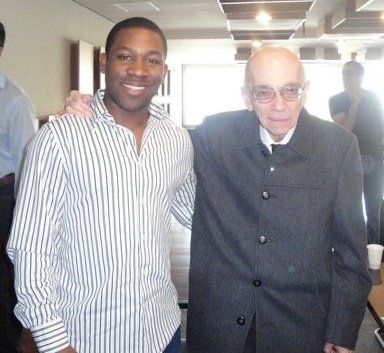
I can't believe a couple of weeks ago marked the six-month anniversary of the first day of Atlanta Music Project classes. Everything is going by so fast! Looking back on my last year and a half, I feel I've come a pretty long way. It turns out the Abreu Fellows Program was an opportunity of a lifetime.
I think back to February of 2009, long before the Abreu Fellows Program existed. I was still in school and visiting Boston for an audition and I distinctly remember telling my cousin and his wife that I wanted to combine my performing with some El Sistema-style educational endeavors. I told my them, if only there was a way I could learn the skills needed to do this. Perhaps I could use a grant-writing course. Maybe I could do a non-profit management seminar. I left Boston brainstorming about doing El Sistema.
Fast forward four months and Dr. Jose Antonio Abreu (pictured with me at the top of my blog), founder of El Sistema, had won the TED Prize. Subsequently the New England Conservatory announced, per Dr. Abreu's wish, a fellowship program to train gifted musicians and music educators in the El Sistema philosophy, non-profit management, community partnerships and music education. The fellowship even included a trip to Venezuela to study El Sistema up close. Of course, I applied and got a spot in the inaugural class of the Abreu Fellows Program. I called my cousins in Boston to tell them I was moving to their city to do exactly what I had told them I wanted to do not four months earlier.
Growing up studying music helped me develop a strong work ethic from an early age, so I found myself quite at home with the busy and hectic schedule offered by the Abreu Fellows Program. It was an intense year, definitely the most I had worked in all my life...until the Atlanta Music Project came along. The joys of running a start-up non-profit include: picking between downtime and no sleep or no downtime and no sleep (I usually pick the former), missing all of March Madness, people asking me why I emailed them at 3:30am, and hoping the other person will pay for that business lunch.
Besides these annoying issues, I can say that I wouldn't trade places with anyone. It's fun as heck. The Atlanta Music Project is fulfilling its mission every day. To see our students developing their musical, social and emotional abilities right before my very eyes is mind boggling. No doubt, this combination of intense musical training and academic tutoring (done by our collaborator, the Atlanta After School All-Stars) is working.
Here are a few highlights on doing El Sistema in Atlanta:
Since moving to Atlanta, I've quickly learned that this is a Coca-Cola town. With its headquarters here in Atlanta, the world's biggest brand has its footprint all over the city, especially when its comes to supporting charitable efforts. The Atlanta Music Project is fortunate to have been awarded a grant from the Coca-Cola Company, which, with generous in-kind donations from our City Of Atlanta Office Of Cultural Affairs, enabled us to launch our program. In July 2010, Coca-Cola invited me to the National Black Arts Festival Gala. I got the chance to meet Atlanta's Mayor, Kasim Reed, for the first time.
Meeting Mayor Kasim Reed for the first time.
Here's some video (courtesy of Armentria Favors of Modern Matter Graphic Design and Art Direction) of our open house, which was held at the end of September 2010 at the Gilbert House, the Atlanta Music Project's first site. People often ask me if we had a recruitment strategy. Well...kind of. Literally 30 minutes before these kids were at our open house, I found them just up the street from the Gilbert House, hanging out in their front yard doing not much. I handed them a flyer for their parents and 30 minutes later they were trying out violins and cellos. It's grassroots, but it worked!
About to start a live interview with Ali Velshi on CNN.
Photo courtesy of Green Theory PR&Marketing.
When I went to Venezuela to observe El Sistema during the Abreu Fellows Program, I visited around 30 music centers, also known as nucleos. They were all very impressive, but some were certainly better than others. I came to the conclusion after much observation, questioning and teaching their students that one thing and one thing only made a nucleo what it was: teachers. If you're building an El Sistema program, especially with limited resources, your key to success will be your teachers' ability to inspire their students to learn, no matter the circumstance. I feel very fortunate that here at the Atlanta Music Project we have amazing teaching artists. Our teaching artists are talented, dedicated, innovative, cooperative, continuously learning and desire nothing but the best for our students. I should also mention the non-music teachers at the Gilbert House who are responsible for our students outside their AMP music classes. They include the two Gilbert House site managers (Armentria Favors and Emory Clark) and the academic tutors (Gloria Glass and Shanna Baker) from the Atlanta After School All Stars. Together, all these teachers get it. They understand why we all do what we do. Simply put, this team of teachers makes the Atlanta Music Project what it is.
Hanging out with Wynton Marsalis after his Jazz At Lincoln Center performance at the Woodruff Arts Center. A big fan of El Sistema, Wynton has been to Venezuela, met Abreu and seen El Sistema for himself. The Atlanta Music Project students also got to meet him and watch his dress rehearsal.
With Wynton Marsalis
Mentoring. Mentoring. Mentoring. This is the reason Gustavo Dudamel and classical music are among the most popular things in Venezuela these days. Every kid in Venezuela knows a kid in their neighbourhood or a distant family member who grew up in an El Sistema program. In Venezuela, being in a youth orchestra is a cool thing to do. At the Atlanta Music Project, we constantly surround our students with talented high school students from the local youth orchestras. I'll never forget the look on the face of one of our trombone students when his trombone mentor walked into the class. How do you convince an 11-year-old that playing the trombone two hours a day is cool? Have a 15-year-old trombonist tell him so. A few weeks ago we took our students to go see the Atlanta Symphony Youth Orchestra perform at the Woodruff Arts Center. It was great to see our students interacting with their Music Mentors, who they see on a weekly basis at AMP classes.
Atlanta Music Project students hang with their music mentors at the Atlanta Symphony Youth Orchestra Concert.
Below is a picture the AMP students performing as a choir during our Winter Performance at the Museum Bar. Our students are a joy to work with. However, some of them, as we expected, do have some behaviour issues. Not that I blame them, it's amazing to hear what some of them have already gone through at their age. But I'm around them so much that I'm privileged to be able to see all the sides of their personalities.
The instance that most caught my attention in these first months was seeing one of our students, who can come off as particularly hardened, backstage before going out to perform. Here was this kid, one of our bigger ones, who can be quite the bully and troublemaker, scared out of his/her mind to go out on stage to perform. I smiled and said to myself "that's the real him/her." I could see it in his/her face. Behind all that bravado was simply a young child: humbled, intimidated, unpolished, innocent and full of potential.
On doing El Sistema in Atlanta, I always keep in mind that, through music, we're developing the true side of our children.
What it's all about. Led by choir director Aisha Bowden, AMP students perform during their Winter Performance.
Photo courtesy of My True Vision Photography.
Next AMP Concert:
If you're in Atlanta, be sure to come check out the Atlanta Music Project Teaching Artists in concert at the Gilbert House on Thursday March 31 at 6pm. More info here.
After the Abreu Fellows graduated, my plan was to continue blogging as the Atlanta Music Project started coming together. I thought it'd be interesting for people to come along for the ride of the developments and ups-and-downs of launching an El Sistema program outside of Venezuela. Well obviously, those blogs never happened and I'd like to blame it on the fact that I was just too busy trying to start the program.
By now you may know that the Atlanta Music Project, the El Sistema-inspired program that I co-founded with our board chair Al Meyers, was successfully launched on October 4, 2010 in Southwest Atlanta, in partnership with the City Of Atlanta Office Of Cultural Affairs. I don't want to bore you with the all the details involved with starting a non-profit. Obviously it's a lot of work and requires a great team, which we have. But what I feel really helped us - and I'd be kidding myself if I didn't admit it - was quite simply, luck. A lot of it. Here's just a few examples from many.
As the new Mayor of Atlanta, Kasim Reed, started his term in January 2010, he announced plans to re-open all the recreation centers so kids would have somewhere to hang out after school. In July 2010, I got a phone call from Camille Love, the Director of the City Of Atlanta's Office Of Cultural Affairs. She wanted the Atlanta Music Project to be one of the after-school programs taking place at the Mayor's recreation centers, starting in September 2010. The Atlanta Music Project now runs out of the Office Of Cultural Affairs' Gilbert House, where we're given the space, administration staff and infrastructure to run our classes. It's a great partnership, that partly comes down to luck and great timing, because if it wasn't for the Mayor and Ms. Love's vision, the Atlanta Music Project may not have launched this quickly.
Me, Camille Love (Director of Cultural Affairs), Al Meyers (Co-Founder and Board Chair of AMP) at a press conference where Mayor Kasim Reed announced the launch of the "Culture Club: An After-School Experience".
The Atlanta Music Project is the provider of music classes in this after-school program.
Here's another one. In April of 2010, the 2010 Abreu Fellows left Caracas to go back to the United States. The first leg of the trip was from Caracas to Atlanta, so I opted to spend our spring break in Atlanta, where I would keep trying to get things going with the Atlanta Music Project. Showered, but unshaven and in need of a haircut, I rented a car at the airport and drove straight to the Woodruff Arts Center, home of the Atlanta Symphony Orchestra, where students of the Talent Development Program were performing.
Students of the Atlanta Symphony Youth Orchestra and the Atlanta Symphony's Talent Development Program at the Gilbert House, giving a performance and demonstration of string instruments to the students of the
Atlanta Music Project.
At the reception for this concert, Melanie Darby, who is on our board of advisors, introduced me to Dr. Stanley Romanstein, the new President of the Atlanta Symphony Orchestra. I asked Dr. Romanstein if we could meet so I could talk to him about my plans for El Sistema in Atlanta. The meeting went great and at the end he asked "So, what do you need?" On the advice of my Abreu Fellows Program mentor, Don Jones, I was prepared for this question. I asked Dr. Romanstein for office space within the Atlanta Symphony Orchestra offices (I was tired of spending my days at coffees shops for their wifi and my evenings going to FedEx to print documents, spending money I didn't have). His exact response was "done." I was actually kind of confused for a second because I had prepared a bunch of reasons why I the office space was needed, but I never had to explain. I believe we were lucky that Dr. Romanstein, who is a former Executive Director of the Baltimore School For The Arts and a champion of music education, joined the Atlanta Symphony literally a few weeks before I arrived in Atlanta from Venezuela. Dr. Romanstein and the Atlanta Symphony Orchestra have been strong supporters of our program from the beginning and I couldn't be more grateful for their support. The timing couldn't have been better.
In February 2010, I went to TED2010 with some of the 2010 Abreu Fellows. I blogged about performing on stage, meeting Will Smith and Sheryl Crow etc. What I didn't tell you then, because I didn't know where it would lead, is that on the last night I walked into the elevator at our hotel and met two TEDsters who happened to work for Coca Cola in Atlanta. They had just seen me perform with the Abreu Fellows on the TED Stage and so they knew all about El Sistema, El Sistema USA and the Abreu Fellows Program. I told them I was planning El Sistema in Atlanta and asked if there was a Coca Cola Foundation I could apply to for funds. They put me in touch with the Coca-Cola Foundation and I met with them later in April. The foundation folks said it sounds like a good idea, but please come back when you have more traction. Fair enough, but not the answer you want to hear when what you need to get traction is, funding. But with the City Of Atlanta partnership developing, we were finally able to secure funding from Coca-Cola that essentially enabled us to launch the program. The Coca-Cola company is still our biggest sponsor to date and I'm thankful for them having taken a leap of faith to support our music for social change initiative. To see all our sponsors and collaborators, please visit this page and this page on the Atlanta Music Project website.
The Abreu Fellows performing at TED2010.
The City Of Atlanta Office Of Cultural Affairs, the Atlanta Symphony Orchestra and the Coca-Cola Company are three of our partners, without whom, the Atlanta Music Project couldn't have launched. When I talk about us being lucky, people often tell me it's not luck but the result of hard work. I certainly believe that is true. We have a board, volunteers and enthusiasts who work tirelessly on our behalf. But I think the two biggest factors in our successful launch are that we have a good mission and we've been lucky. So far, no one has told me (at least not to my face!), that what we're doing here is not both needed and positive. I believe that what El Sistema has done in Venezuela and what the Abreu Fellows Program has become in the United States, is extremely credible, and we at the Atlanta Music Project are just a small part of a huge movement to save lives with music. With all these elements supporting us, time and time again, my planning team and I found ourselves in the right place at the right time, with good fortune that helped advance our launch.
In the end it is most important that our luck as a planning team has found its way to the community. Our students now have the opportunity to learn an instrument, sing in a choir, learn musicianship and play in orchestra, right in their own neighbourhood everyday of the week. They're great kids and I'll tell you a little bit about them in my next blog. Comments, concerns and questions about my blog or the Atlanta Music Project are always appreciated. Thank you for reading!
Graduation Day. Just like that, a whole school year has flown by and my Abreu Fellowship colleagues and I have graduated. And we're now on to the reality of leading El Sistema programs outside of Venezuela.
For our graduation the New England Conservatory arranged a great little ceremony and reception for us. In attendance were many of the seminar leaders we had had over the year as well as NEC board members, faculty and staff. I enjoyed seeing both of my mentors in the audience: NEC viola faculty Martha Katz and NEC Vice-President for Institutional Development, Don Jones. The superb Marcus Santos, who led our Samba percussion workshop in January also showed up. And Martha, our spanish teacher was present with her new 3-week old baby boy. Oh, and how could I forget Anna Verghese and Amy Novogratz from the TED Prize! It feels like only yesterday they were interviewing me for the fellowship.
With the Amy Novogratz and Anna Verghese of the TED Prize production team
The ceremony opened with Katie Wyatt and I playing a couple of movements from Bach's First Suite for Cello, and Katie encored with a beautiful rendition of a song we heard many, many, many, many times in Venezuela, aptly titled "Venezuela". I didn't do nearly enough concertizing this year so when we were offered the chance to perform at the graduation I jumped at it.
The two Abreu Fellows doing El Sistema in the South. Katie Wyatt in Durham and myself in Atlanta.
As this was my fourth post-secondary graduation, I selfishly decided I had earned the right to dress the way I wanted. I wore khakis, a collared shirt and on top of that a t-shirt that was hand-made and given to me by one of the mothers of a child from the nucleo in Acarigua. It read: "YO SOY100% FESNOJIV" (I am 100% El Sistema), and below that were the Venzuelan flag and Canadian flag side-by-side. I thought it was appropriate attire and nobody complained (to my face).
Following the music we began our group presentation, very similar to the one we did in Los Angeles, basically reflecting on our time in Venezuela through anecdotes, stories, pictures and videos. I again told the story of 10-year old Carlos in Acarigua, who, nine days after I gave him his first bassoon lesson, was thrown into the nucleo orchestra to play Tchaikovsky's 1812 Overture in concert. It's a great story that represents what El Sistema is about in so many ways. I discuss this in more detail in my blog post on our time in Acarigua, Venezuela.
I have to say, after doing this presentation for Dr. Abreu in Caracas, in Los Angeles for 200 professional music educators, administrators and musicians, we had it down pretty good. I am particularly happy with having had so many opportunities to do public speaking throughout the year as I know it will come in very handy during the coming years doing this work. I'm still more comfortable playing the bassoon in public but compared to last October when just starting the fellowship, speaking in public is now a lot easier. In fact I quite enjoy it and would be lying if I said it wasn't fun. It doesn't hurt to have something so inspiring as El Sistema to talk about. It practically pitches itself!
Our presentation was followed by the presentation of the Abreu Fellows Program certificates, a reception in the office of NEC President, Tony Woodcock and tons of pictures.
At the post-graduation reception with El Sistema USA Director Mark Churchill and El Sistema USA Managing Director, Stephanie Scherpf.
AND NOW FOR NEXT YEAR...
This year of training went by very fast and has come to an end for us, the first class of Abreu Fellows, but the journey of playing our part as ambassadors of El Sistema has really just begun.
I should mention that I'm thrilled to learn that 10 new Abreu Fellows have been selected to form the second class. We've met quite a few of them already and read their biographies. As you will see soon when they are officially announced, they are a stellar group and I look forward to getting to know them better and working alongside them in the future. Remember, Abreu's TED Prize wish was to train 50 fellows, so this program will be around for at least the next four years and hopefully more. If you're thinking of applying, don't wait until the fifth year because it's going to get harder and harder to get accepted as more and more people apply for the fellowship.
Abreu Fellow and my "El Sistema in the South" partner in crime, Katie Wyatt, performs at the Abreu Fellows graduation ceremony.
As for the the first class of Fellows, we're taking our training and experiences to the real world. After spending the year searching for job opportunities, being recruited, doing interviews and tons of travelling, we'll be playing leading roles in El Sistema program all over the United States. Here's how it's breaking out:
Lorrie Heagy is returning to Juneau, Alaska to initiate Juneau Music Matters, Dan Berkowitz is Manager of the Los Angeles Philharmonic's YOLA, Christine Witkowski is leading YOLA's second site called YOLA at HOLA (Heart of Los Angeles), Alvaro Rodas is founding the Corona Youth Music Project in Queens, NY, David Malek and Rebecca Levi are co-directing a program in Boston at the Conservatory Lab Charter School, my main man Stanford Thompson is director of Tune-Up Philly, a program of the Philadelphia Youth Orchestra, and Katie Wyatt is executive director of KidzNotes in Durham, NC. As for me, I will head to down to Atlanta as executive director of the Atlanta Music Project.
The Atlanta Music Project will launch its pilot year in late 2010 in an underserved community in Atlanta. I have a great team in Atlanta and we've been working hard all year to get this program off the ground. It was hard to balance learning a bunch of new skills in the fellowship while applying them literally at the same time to a real world project. Several times I found myself in Venezuela working late into the night on the Atlanta Music Project. Balancing the fellowship curriculum, the Venezuelan residency and working on next year's project was a handful but at the same time it was exhilarating to be able to watch something spectacular in Venezuela during the day and then go back to the hotel at night and immediately apply what I had seen to a real-life project. I can assure you that all the other fellows were doing the same routine as me this year in order to have their programs launch on time too. El Sistema is very nice and all but no one ever said it was easy. A few times I asked myself what the hell I had signed up for. This year was a steep learning curve and sometimes I feel like we're all crazy to be jumping into this. But then again everyone thought Dr. Abreu was crazy too...
The Abreu Fellows back at the beginning of the fellowship in October 2009.
For me, the best thing about the Abreu Fellows Program is that it has given me the opportunity to engage in something that I felt was in me all along but was going to be hard to manifest itself from me simply playing the bassoon. I've always been sort of impatient and had low tolerance for injustice and inequality but I felt I couldn't do much about that by simply playing in orchestra, and this always bothered me. But thanks to the Abreu Fellowship, I now have a way to use music as a vehicle for something even greater.
Towards the end of our first meeting with Dr. Abreu in Caracas, he began to thank everyone for helping make the Abreu Fellows Program come true. Then, he sort of jokingly thanked himself for thinking of the idea of the Abreu Fellows Program. Later that day, one of Dr. Abreu's aids mentioned to us that that was the first time he'd ever heard Dr. Abreu give himself credit for any of the work he has done. I think he's right to thank himself, and I thank him too. Nobel Peace Prize for Dr. Abreu?
As I said, the real fun is only just beginning for my colleagues and I. Of course I will continue blogging about all things Atlanta Music Project, El Sistema and Abreu Fellows for (hopefully) many more years to come. Thank you for following my blog this year and please stay tuned for more!
Back in May 2010 each Abreu Fellow interned at an El Sistema-inspired program somewhere outside of Venezuela. The idea was to experience how a program took its understanding of El Sistema concepts and applied them to their own community. The fellows interned at programs in San Antonio, Los Angeles, Pasadena, Cleveland, Chicago, New York, Scotland and myself in Baltimore with the OrchKids program.
I arrived on the scene on May 16th, the night 60 Minutes aired their segment on Gustavo Dudamel, the LA Phil's Youth Orchestra Los Angeles (YOLA) and the Baltimore Symphony Orchestra's OrchKids program. I watched the segment with Dan Trahey, program director and Eli Worth, program conductor. Dan was pacing beforehand but I think he was quite thrilled with the outcome. I also thought it was a good segment. But since they were focusing on the spread of El Sistema in the USA I just wished they would had mentioned El Sistema USA or the Abreu Fellows. They did have a short clip of Mark Churchill (El Sistema USA/Abreu Fellows Program Director) speaking but only referred to him as "the head of El Sistema in the USA." It's a curious omission but I can understand this somewhat after spending the year trying to explain the complex links between Jose Antonio Abreu and the Abreu Fellows Program. It's not easy.
Just to recap (or explain, for newcomers), the short, incomplete version goes something like this:
-Jose Antonio Abreu launches El Sistema in Caracas, Venezuela in 1975 with 11 kids in a parking garage.
- In the 1990s El Sistema forms a National Children's Orchestra, of which Gustavo Dudamel is a part as a violinist and conductor. They eventually take on the name of Simon Bolivar Youth Orchestra "B".
-Gustavo Dudamel wins the Gustav Mahler Conducting Competition in 2004. Everyone asks "Who is this kid and where does he come from?" The answer is, of course, he is a product of El Sistema (El who?).
-Somewhere during this time, Mark Churchill, Dean of the Prep School and of Continuing Education at the New England Conservatory, takes note of this national youth orchestra program in Venezula. This is the beginning of a long relationship between Churchill and NEC and Jose Antonio Abreu and El Sistema.
-Dudamel's victory in the Mahler competition leads to instant curiousity and eventually recognition of El Sistema, their Simon Bolivar Orchestra and Gustavo Dudamel. Who knew there were 350,000 kids playing in neighbourhood youth orchestras everyday after school all over a country better known for its oil, its president and its Miss Universes.
-Cue concerts with the Simon Bolivar Youth Orchestra B and Dudamel all over the world, including the London Proms, La Scala, Carnegie Hall and Walt Disney Concert Hall. Plus hundreds of thousands of hits on YouTube.
-Jose Antonio Abreu is garnering prizes all over the world, including in the United States, the TED Prize, which is worth $100,000 and "one wish." His wish: to create the Abreu Fellows Program in order to train musicians to start El Sistema in the United States and beyond.
-Given its relationship with El Sistema in Venezuela, the New England Conservatory hosts the Abreu Fellows Program. El Sistema USA, a networking and resource organization, is formed to spearhead the Abreu Fellows Program and connect other American (and other) El Sistema programs to each other. Mark Churchill is director of both the Abreu Fellows Program and El Sistema USA.
-The Abreu Fellows study El Sistema all year (2009-2010), including trips to Venezuela and various US-based El Sistema-like programs.
Simple no? If you have questions or want to add or correct anything, please feel free to add your comment below the end of the blog.
Back to Baltimore. I believe the Baltimore Symphony OrchKids program has the right idea with its educational and community pursuits because just like El Sistema, they're using music to uplift youths and communities. An orchestra's weapon of contribution is music, and by bringing it to the community, especially underserved communities, the Baltimore Symphony Orchestra is winning the hearts of many, many people (including 60 Minutes), some of whom have never been anywhere near a symphony orchestra. I say it's a "weapon" because music, in this instance, is consciously being used as a tool to combat povery of spirit, lack of motivation and an abundance of free time. And when I say "bringing music to the community" I mean, putting instruments in the youths' hands...several times a week...all year long...all over the city.
The OrchKids Program wants all 82,000 Baltimore City Public School students to eventually be part of their program. It's a lofty goal, but I think it's the right direction to go in. I saw their 10-year plan. If they're able to stick to it, tickets to the Baltimore Symphony will be hard to come by in 10-15 years. To be sure, it's certainly an investment, but in due time, those kids (and their parents, friends and families) will have a life-long appreciation of the Baltimore Symphony. This kind of hands-on, sustained investment in youths and communities ought to be part of any good philanthropic plan if symphony orchestras are going to continue to be relevant in their own cities.
For more program details and behind the scenes footage on the Baltimore Symphony Orchestra OrchKids Program please see my blogs from November 2009 here and here.
I arrived at the OrchKids Program as they were preparing their end of the year concert. The idea was to turn the Lockerman Bundy Elementary School gym into a lavish concert hall. Baltimore Symphony music director Marin Alsop was to come conduct AND play violin as part of the concert (that's her in the picture on the left at the dress rehearsal). Certainly the program could have rented a nice hall, but I thought it was a strong statement by the BSO to bring the music to the school, which is in West Baltimore.
Along with some other volunteers and interns, I was tasked with helping out with the concert production, striking the stage, teaching some classes and acting as a stage hand during the concert.
Here's how we decorated the gym. First off, we needed to cover the hideous, beige, concrete-blocked walls with something more fancy. So we went to Wal-Mart and bought loads of black material to cover the walls. We used velcro tape to hang it. We ran white Christmas lights along the edge of the material. An actual three-foot stage was brought in for the ensembles to play on top of. We covered portable chalk boards with black construction paper to create the stage wings. We bought small floodlamps and fitted them strategically around the gym to create mood lighting. We needed lights aimed at the stage so using a ladder and some zip ties we fixed some floodlights to the basketball nets and pointed them toward the stage. We decorated the edge of the stage and the music stands with music notes cut out of construction paper. 300+ chairs were brought in for the audience, which included the familes, teachers and donors. Add the American flag, the State of Maryland flag and a podium for speeches. We turned off the gym lights, turned on the floodlights, turned on the air conditioning (which never ended up working) and VOILA, the gym was turned into a "concert hall". The picture of the dress rehearsal below and to the right shows our work.
Flyers were made to announce the concert which was given the name:
"A Night With The Future: A Community Affair".
The concert involved about 150 OrchKids. There were several choir pieces, including Beyonce's "Halo", a bucket band number led by Baltimore Symphony percussionist Brian Pretchl, a piece for piano and orchestra featuring Peabody Conservatory Marian Hahm on piano, a woodwind ensemble, a Stevie Wonder piece, a blues where every kid on stage took a solo and Baltimore Symphony music director Marin Alsop conducted the OrchKids orchestra in Amazing Grace. Marin also played violin in one of the pieces. The OrchKids teachers played with the kids on stage when needed but they made a point of staying out of the way and keeping the focus on the students. The kids performed admirably. The oldest are only in third grade and if they keep going at this rate they're going to be virtuosos.
The concert was followed by a reception in the school cafeteria where donors mingled with parents and kids with teachers. It truly was a community affair with the focus on "the future."
The OrchKids program embodies many of the concepts and philosophies I saw in Venezuela, indeed their program leadership (Dan Trahey and Nick Skinner) spent some time in Acarigua, before the Abreu Fellows Program even existed, so they certainly know what they're doing. By keeping the focus on the music, the kids and the community I'm certain the Baltimore Symphony Orchestra will become an even bigger part of the city.
Please stay tuned for my next blog which will come out before the end of this week. It will include writings on our graduation, the new class of Abreu Fellows and my and the fellows' plans for next year.
Abreu Fellows and students from Youth And Enrichment Family Services at Menino Arts Center. Boston, 01/24/10
Video of Abreu Fellows' first semester:
WELCOME BACK TO MY BLOG ON THE 2009-2010 ABREU FELLOWS PROGRAM!
Since I haven't blogged in almost two months, this post is a little long. But so much has happened that I don't want to leave anything out. And don't worry, it's mostly pictures.
As most of you know, after this year of training the fellows are expected to spend one year (and hopefully longer!) as part of an El Sistema-inpsired program somewhere in the world. So you'll begin to notice that everything that's been happening is helping to propel us towards next's year goal.
Let's go back to December of 2009.
My roommate Stan and I had the opportunity to go to Atlanta, Georgia to discuss the possibility of an El Sistema-style program there. We met with several people from the music performance, music education and non-profit world. We also attended a TED conference, TEDxPeachtree, hosted by Al Meyers.
For those who don't know what TED (Technology, Entertainment and Design) is, it is essentially a non-profit organization that promotes "ideas worth spreading." TED holds their annual conference each year in Long Beach, California. It is at this conference that they announce the TEDPrize. The winners of this prestigious prize win $100, 000 and "one wish to change the world." In 2009, Jose Antonio Abreu, the founder of Venezuela's El Sistema won the TEDPrize and his wish was to start a special training program in the United States for musicians to spread the El Sistema idea to all parts of the world. The Abreu Fellows Program is his wish coming to fruition.
At TEDxPeachtree, organizer Al Meyers, gave Stan the opportunity to do a sort of mini TED Talk on the possibility of starting an El Sistema-inspired program in Atlanta. This is quite an honor. Stan did great (see Stan's talk and presentation here) and we managed to get a few people interested in helping move the process foward.
If you've never seen TED Talks, take your computer, find a comfortable seat and check them out. The talks are given by world's most creative, innovative and inspiring people (like Abreu). Some of them will blow your mind.
Stan and Me, with Melanie Darby and Reggie Brayon at TEDxPeachtree.
Stan is from Atlanta and his mom is a music teacher in the public school system, so we took that as an opportunity to coach some students at her high school.
Our professional meetings in Atlanta were very productive and it looks like Atlanta has the right combination of a strong arts community (Atlanta Symphony Orchestra, ten youth orchestras and marching bands galore!) and plenty of youth to serve. Defintely furtile ground to start an El Sistema-inspired program.
Back to the pedagogical side of things now.
One of the biggest issues with starting a new music program is deciding what age group and which instruments to start with. Throughout our studies it seems that two instruments are consistently a safe bet: voice (choirs) and percussion.
Abreu Fellows, Christine and Alvaro during percussion seminar with Jerry Leake
We learned percussion techniques and rhythms from North and South India, West Africa, particularly Ghana, and Brazil (Samba Reggae, Samba and Samba Funk).
The reason for having percussion be a part of a music program from the beginning is that it's makes it easy for everyone to be involved right away. Hitting the bucket, djembe, repique or surdo makes an immediate sound and incorporating things like call and response, dynamics, singing and dancing provides an exilirating ensemble experience, much like playing Mahler or Brahms in a symphony orchestra. Most of the time you don't need to know how to read music to do it and it'll teach one of the most important aspects of playing music: rhythm.
This is important for kids because sometimes, especially in elementary school, to start having fun on the violin or the clarinet, it takes a long time. Producing a satisfying sound, learning the fingerings and how to read music can be a slow process at first and a child may lose interest if they are not encouraged daily. By having a percussion ensemble, they get access to a musical group performance right away. It gets them "hooked" from the get-go while they slowly build their skill on their orchestral instrument.
Speaking of percussion and Brazil, I will divulge that last semester, with the encouragement of my mentor, New England Conservatory Viola Faculty, Martha Katz, I spent a weekend amongst Brazilians in Boston. I took a Samba class, (in which I required much assistance) and the next day I took a Samba percussion workshop, (which went much better).
At Samba class with my roommate Rebecca (on the right).
I am convinced the reason that Brazilians are so good at soccer is because they dance Samba. Quick feet, a neccesity for both Samba and good ball control in soccer. I have slow feet, which is why I'm good at neither...
The Samba percussion workshop was lead Meia Noite, who hails from Salvador Da Bahia, Brazil, where Carnaval (the biggest street party in the world) happens every year.
Shout out to my good friend Jan who should be making his way to Salvador for Carnaval in the next few weeks.
Now back to Meia Noite. Quite simply, he is amazing. He has been Sergio Mendez' principal percussionist for years and has played with Madonna, among others. Check out this video I took from his workshop. In the video he is playing the "Caixa" with a drumstick in his left hand and using his right hand to also strike the drum. Take note of all the different sounds he gets with only one drum and also watch for the call and response between him and the class towards the end of the video. How could any kid not enjoy doing this?
We have also continued our outreach activities with different music programs in the Boston area. You'll remember that last November we visited Youth and Family Enrichment Services (YOFES) which targets the Haitian community in Boston. Yesterday, January 24, 2010 we returned to do an outreach gig with their students. They have a Suzuki string program involving more than 50 kids.
We had set up the outreach date back in November, but in the wake of the earthquake in Haiti, it seemed even more important for us to do this gig.
With Geralde Gabeau, Director of YOFES and Ms. Heidie J. Jean, Violin Instructor
We started off by watching their violin and viola students playing Lightly Row and Twinkle, Twinkle, which are two standard beginner pieces from the Suzuki Method. All the kids played from memory with great big sounds and solid rhythm. Credit to their teacher Ms. Heidie J. Jean.
Following this the Fellows demonstrated our instruments and played a few solo and duo pieces. We then premiered a wonderful new piece titled Puesta Del Sol, composed by New England Conservatory composition student Albert Oppenheimer. Nicely done Albert! And to finish off, the fellows and students took the stage together to play some Haitian folk tunes. The parents joined in singing the words, while one parent even played percussion on a chair. For me this was easily the highlight of the night.
Playing "Haiti Cherie" with the YOFES students.
YOFES then graciously invited us to stay for a dinner of delicious Haitian food including the classic rice and beans and fried plantains.
A big thank you to Geralde Gabeau, director of YOFES, for having us. YOFES has their own Earthquake Relief efforts aimed at Haiti and the Haitian community in Boston. Please go to the YOFES' website to find out how you can help.
Switching gears back to TED for a moment.
Last December an announcement was made that five of the fellows had been invited to Long Beach, California to attend the TED Conference in February 2010. And not only that. But as a group, the five us will be speaking at the 2010 TED Prize presentation.
Unfortunately they could not invite all ten of us and I assume it probably has something to do with the $6000 it costs to get into the conference...
Along with me, TED has invited Christine, David and my roommates Stan and Rebecca. I don't want to give away exactly what we'll be doing on stage but obviously it will be related to Abreu's TED Prize wish. Tune in online at 5pm Pacific Time on February 10 to watch live!
Here's a sneak peak at our rehearsals in Boston which were directed by artist and TED veteran, Rives:
L to R: Me, Dave, Christine, Stan and Rebecca (off camera) for our TED Conference presentation.
I'll admit I'm feeling a bit of pressure with this thing since public speaking is not my background and apparently the TED Prize is watched live online by millions around the world, not to mention the 1500 people sitting in the audience. I've played concerts at Carnegie Hall...no problem! But this? Yikes...
Also coming up quickly is our residency in Venezuela to study El Sistema in person. We're finally starting to get some details surrounding the trip.
We will be leaving on February 18th and will be there for two months. We will be spending the first week in Caracas and then breaking up into groups to go teach, study and perform at various nucleos in different parts of Venezuela. The latest word is that during this first week we will be attending a gala in Caracas celebrating the 35th anniversary of El Sistema Venezuela where we will meet Abreu and watch Gustavo Dudamel a conduct the Simon Bolivar Youth Orchestra. We're told that we will also participate in rehearsals with the Simon Bolivar Youth Orchestras so we can get a feel of what it is like to play in their orchestra.
I'm looking foward to teaching and performing with the El Sistema kids. My spanish is not bad, as long as I don't have to speak in the future tense. I'm especially looking foward to not having to wear boots, coats and tuques. Mid-February, the best time to head south from the winter weather...
Kudos to Dan Berkowitz, one of the ten original Abreu Fellows. Over the holiday break Dan was offered and accepted the position of Manager of Youth Orchestra Los Angeles, the LA Philharmonic's El Sistema-program. Dan is already out in LA working hard, but will be with us when we arrive in Caracas in February. Congrats Dan!
And to finish up, shout out to my friend and Yale School of Music classmate Robert Gupta. I still remember the conversation we had the day of graduation:
Gupta: hey Dantes, so what are you up to next year?
Me: Oh, I'm going to do more graduate work in Pittsburgh. How about you man?
Gupta: Oh, I won the Los Angeles Philharmonic violin audition a fews days ago.
Me: (gulp)
Gupta won his first audition, at the age of 19, with one of the best orchestras in the world. But of course, if you knew him you wouldn't be too surprised. In any case, Gupta has been named a 2010 TED Conference Fellow, quite an honor, so he'll be in Long Beach, CA at the same TED Conference we'll be. Gupta, see you soon.
More from the Abreu Fellows Program in about a week. It's been a while and I'd love to hear from you, so please leave your comments or questions down below.