Showing posts with label Gustavo Dudamel. Show all posts

Tuesday, June 22, 2010

El Sistema in the USA: The Baltimore Symphony Orchestra OrchKids Program


Back in May 2010 each Abreu Fellow interned at an El Sistema-inspired program somewhere outside of Venezuela. The idea was to experience how a program took its understanding of El Sistema concepts and applied them to their own community. The fellows interned at programs in San Antonio, Los Angeles, Pasadena, Cleveland, Chicago, New York, Scotland and myself in Baltimore with the OrchKids program.

I arrived on the scene on May 16th, the night 60 Minutes aired their segment on Gustavo Dudamel, the LA Phil's Youth Orchestra Los Angeles (YOLA) and the Baltimore Symphony Orchestra's OrchKids program. I watched the segment with Dan Trahey, program director and Eli Worth, program conductor. Dan was pacing beforehand but I think he was quite thrilled with the outcome. I  also thought it was a good segment. But since they were focusing on the spread of El Sistema in the USA I just wished they would had mentioned El Sistema USA or the Abreu Fellows. They did have a short clip of Mark Churchill (El Sistema USA/Abreu Fellows Program Director) speaking but only referred to him as "the head of El Sistema in the USA."  It's a curious omission but I can understand this somewhat after spending the year trying to explain the complex links between Jose Antonio Abreu and the Abreu Fellows Program. It's not easy.

Just to recap (or explain, for newcomers), the short, incomplete version goes something like this:

-Jose Antonio Abreu launches El Sistema in Caracas, Venezuela in 1975 with 11 kids in a parking garage.

- In the 1990s El Sistema forms a National Children's Orchestra, of which Gustavo Dudamel is a part as a violinist and conductor. They eventually take on the name of Simon Bolivar Youth Orchestra "B".

-Gustavo Dudamel wins the Gustav Mahler Conducting Competition in 2004. Everyone asks "Who is this kid and where does he come from?" The answer is, of course, he is a product of El Sistema (El who?).

-Somewhere during this time, Mark Churchill, Dean of the Prep School and of Continuing Education at the New England Conservatory, takes note of this national youth orchestra program in Venezula. This is the beginning of a long relationship between Churchill and NEC and Jose Antonio Abreu and El Sistema.

-Dudamel's victory in the Mahler competition leads to instant curiousity and eventually recognition of El Sistema, their Simon Bolivar Orchestra and Gustavo Dudamel. Who knew there were 350,000 kids playing in neighbourhood youth orchestras everyday after school all over a country better known for its oil, its president and its Miss Universes.

-Cue concerts with the Simon Bolivar Youth Orchestra B and Dudamel all over the world, including the London Proms, La Scala, Carnegie Hall and Walt Disney Concert Hall. Plus hundreds of thousands of hits on YouTube.

-Dudamel is named music director of the Los Angeles Philharmonic.

-Jose Antonio Abreu is garnering prizes all over the world, including in the United States, the TED Prize, which is worth $100,000 and "one wish." His wish: to create the Abreu Fellows Program in order to train musicians to start El Sistema in the United States and beyond.

-Given its relationship with El Sistema in Venezuela, the New England Conservatory hosts the Abreu Fellows Program. El Sistema USA, a networking and resource organization, is formed to spearhead the Abreu Fellows Program and connect other American (and other) El Sistema programs to each other. Mark Churchill is director of both the Abreu Fellows Program and El Sistema USA.

-The Abreu Fellows study El Sistema all year (2009-2010), including trips to Venezuela and various US-based El Sistema-like programs.

Simple no? If you have questions or want to add or correct anything, please feel free to add your comment below the end of the blog.

Back to Baltimore. I believe the Baltimore Symphony OrchKids program has the right idea with its educational and community pursuits because just like El Sistema, they're using music to uplift youths and communities. An orchestra's weapon of contribution is music, and by bringing it to the community, especially underserved communities, the Baltimore Symphony Orchestra is winning the hearts of many, many people (including 60 Minutes), some of whom have never been anywhere near a symphony orchestra. I say it's a "weapon" because music, in this instance, is consciously being used as a tool to combat povery of spirit, lack of motivation and an abundance of free time. And when I say "bringing music to the community" I mean, putting instruments in the youths' hands...several times a week...all year long...all over the city.

The OrchKids Program wants all 82,000 Baltimore City Public School students to eventually be part of their program. It's a lofty goal, but I think it's the right direction to go in. I saw their 10-year plan. If they're able to stick to it, tickets to the Baltimore Symphony will be hard to come by in 10-15 years. To be sure, it's certainly an investment, but in due time, those kids (and their parents, friends and families) will have a life-long appreciation of the Baltimore Symphony. This kind of hands-on, sustained investment in youths and communities ought to be part of any good philanthropic plan if symphony orchestras are going to continue to be relevant in their own cities.

For more program details and behind the scenes footage on the Baltimore Symphony Orchestra OrchKids Program please see my blogs from November 2009 here and here.

I arrived at the OrchKids Program as they were preparing their end of the year concert. The idea was to turn the Lockerman Bundy Elementary School gym into a lavish concert hall. Baltimore Symphony music director Marin Alsop was to come conduct AND play violin as part of the concert (that's her in the picture on the left at the dress rehearsal). Certainly the program could have rented a nice hall, but I thought it was a strong statement by the BSO to bring the music to the school, which is in West Baltimore.

Along with some other volunteers and interns, I was tasked with helping out with the concert production, striking the stage, teaching some classes and acting as a stage hand during the concert.

Here's how we decorated the gym. First off, we needed to cover the hideous, beige, concrete-blocked walls with something more fancy. So we went to Wal-Mart and bought loads of black material to cover the walls. We used velcro tape to hang it. We ran white Christmas lights along the edge of the material. An actual three-foot stage was brought in for the ensembles to play on top of. We covered portable chalk boards with black construction paper to create the stage wings. We bought small floodlamps and fitted them strategically around the gym to create mood lighting. We needed lights aimed at the stage so using a ladder and some zip ties we fixed some floodlights to the basketball nets and pointed them toward the stage. We decorated the edge of the stage and the music stands with music notes cut out of construction paper. 300+ chairs were brought in for the audience, which included the familes, teachers and donors. Add the American flag, the State of Maryland flag and a podium for speeches. We turned off the gym lights, turned on the floodlights, turned on the air conditioning (which never ended up working) and VOILA, the gym was turned into a "concert hall". The picture of the dress rehearsal below and to the right shows our work.


Flyers were made to announce the concert which was given the name:

"A Night With The Future: A Community Affair".

The concert involved about 150 OrchKids. There were several choir pieces, including Beyonce's "Halo", a bucket band number led by Baltimore Symphony percussionist Brian Pretchl, a piece for piano and orchestra featuring Peabody Conservatory Marian Hahm on piano, a woodwind ensemble, a Stevie Wonder piece, a blues where every kid on stage took a solo and Baltimore Symphony music director Marin Alsop conducted the OrchKids orchestra in Amazing Grace. Marin also played violin in one of the pieces. The OrchKids teachers played with the kids on stage when needed but they made a point of staying out of the way and keeping the focus on the students. The kids performed admirably. The oldest are only in third grade and if they keep going at this rate they're going to be virtuosos.


The concert was followed by a reception in the school cafeteria where donors mingled with parents and kids with teachers. It truly was a community affair with the focus on "the future."

The OrchKids program embodies many of the concepts and philosophies I saw in Venezuela, indeed their program leadership (Dan Trahey and Nick Skinner) spent some time in Acarigua, before the Abreu Fellows Program even existed, so they certainly know what they're doing. By keeping the focus on the music, the kids and the community I'm certain the Baltimore Symphony Orchestra will become an even bigger part of the city.

Please stay tuned for my next blog which will come out before the end of this week. It will include writings on our graduation, the new class of Abreu Fellows and my and the fellows' plans for next year.


Monday, May 17, 2010

CATCH UP!

LET’S DO SOME CATCHING UP SHALL WE?


HOLY WEEK WITH THE NEW NATIONAL CHILDREN’S ORCHESTRA

I promised a surprise in my last blog, which was written in Venezuela, so here it is:

In an awesome example of how far El Sistema has come in the last 35 years, they are now putting out a fourth national orchestra. Just to be clear, there are presently 3 El Sistema orchestras that get their musicians from all over the country:

1) Simon Bolivar Youth Orchestra A: An excellent orchestra of El Sistema veterans and graduates that performs mainly in Venezuela,

2) Simon Bolivar Youth Orchestra B: They play all over the world and we’ve seen them on YouTube. They actually started out as a national children’s orchestra (later changing their name to the Simon Bolivar Youth Orchestra) and slowly developed into the phenomenon they are today, with Gustavo Dudamel winning the Mahler conducting competition acting as a catalyst for the international El Sistema boom. Many of the players in Simon Bolivar “B” have been playing together since they were 10 or 11 years old. Indeed Dudamel himself was a violinist in the orchestra when he was growing up, and got one of his first conducting opportunities when a conductor was late to rehearsal and he voluntarily stepped in to conduct.

3) Teresa Careno Youth Orchestra: a national orchestra of high school students. If you’ve seen Abreu’s TED Prize video, you’ve seen this marvelous orchestra.

And now, there’s a new, fourth orchestra: the National Children’s Orchestra, comprised of kids 15 years old and under. Their first week of rehearsals was held during Holy Week in Caracas and the Abreu Fellows were graciously invited to watch. We’re not allowed to show any videos or pictures of the orchestra yet so I’ll attempt to describe the scene.

The rehearsals are complete madness. Happening simultaneously we had: 358 kids playing Mahler’s 1st symphony. 20 basses. 18 bassoons. A trillion violins. A coach for every instrument section. Too many apprentice conductors. And running the rehearsal is Jose Antonio Abreu himself, sitting comfortably behind the apprentice conductor sipping ice tea. Yes, that’s correct, the 71-year-old founder of El Sistema still runs rehearsals. This is his baby, after all.

During the rehearsals the kids are told to sit tight because there’s a surprise for them. A few minutes later in walks Gustavo Dudamel. The kids go nuts. I almost start screaming myself but then remember that I am a guest and seated at the front of the room where I can be seen.

They play through Mahler 1, 4th movement for Gustavo. Then the teachers ask him if he has any comments and if he’d maybe like to conduct. The crowd goes nuts again. Gustavo can’t say no. Off comes the watch and out of the pocket the cell phone goes. He looks for a baton and within a few seconds there are a dozen batons in his face. He picks one. It doesn’t feel right. He picks another and steps onto the podium. He turns the score to the beginning of the 4th movement. He then proceeds to conduct the whole movement and never turns a page in the score. The kids play amazingly, like it’s their last day on earth. He then rehearses the orchestra, still without ever using the score, as the kids hang on to his every last word. Without question Dudamel is a rock star. The plan for this new children’s orchestra is for them to go on tour with a world-renowned conductor who I’m not allowed to mention, yet. Watch out.

Oh, I forgot to mention the six (maybe seven)-year old simply known as “Volcan.” He’s a percussionist who successfully auditioned for a spot in the children’s orchestra. In his spare time he conducts (and you should be accustomed to these stories by now), so of course, he was put on the podium for Dudamel, Abreu and the Fellows to watch him conduct, from memory, the 358 musicians in Venezuela’s national anthem. I have the video of this if you don’t believe me, I’m just not allowed to show it to you.

With "Volcan" and Luis Cordova, bassoonist with the Simon Bolivar Youth Orchestra "B"


CUMANA

Cumana

I need to mention my week with Stan in Cumana, a beach town on the coast of eastern Venezuela. The nucleo there was preparing for a concert to be performed in Caracas. Among the repertoire was Shostakovich’s 10th symphony, a staple of all the El Sistema orchestras. I should mention that they were also preparing some great Latin American repertoire. I’ve said it before and I’ll say it again: I believe a symphony orchestra in this day and age is not limited to Mozart and Beethoven. It is an instrument that can play any kind of music with any kind of artist. Indeed many North American orchestras play various genres throughout their seasons and many of my highly trained colleagues from my school days play with hip-hop artists like Kanye West and Common. I hope to see this trend continue alongside the Tchaikovskys, Bachs and Brahms.

One thing I loved about Cumana was that people wear shorts. Being close to the beach, flip flops and surfer shorts were the norm. This was good for me because otherwise I would have stood out as a tourist with my khaki shorts and high white socks (I forgot to pack short socks).

Cumana, fitting in with my high socks and shorts.

The students at the nucleo promised to take me to the beach but of course that never happened because of the intensive concert preparation. Instead of beaching it on the coast on Sunday morning, I spent it coaching bassoonists from the entire state of Sucre (where Cumana is). I can’t complain, I had a great time. I also gave away the rest of the bassoon materials I brought down to Venezuela courtesy of Sue Heineman and Matthew Ruggiero.

In Cumana with the bassoonists from the State of Sucre Orchestra

I should mention the dedication to the nucleo that many former music students demonstrate, and not just in lip service. Many of them have jobs, engineers and accountants for example but continue to teach at the nucleo on a weekly basis. Abreu talks about music affecting the student, the student’s family and the community. Well these former students have gone on to great careers for themselves, certainly helping their families along the way and giving back to the community by teaching at the nucleo. Enough said.

Cumana, la playa.

CAMERATA LATINOAMERICANA AT HARVARD

I want to plug our Venezuelan colleagues living in Boston. They have a chamber orchestra called Camerata Latinoamericana and they performed at Harvard University’s Kennedy School of Government a few weeks ago. A few of the players grew up with Dudamel. The week before the concert, Dudamel happened to be in Boston to receive a prize at MIT. My Boston-based Venezuelan colleagues tell me that while Dudamel was in Boston they snuck him into their school (late at night to avoid attention) and away from the lights and cameras Dudamel quietly coached the group; his friends who he came up with in his hometown of Barquisimeto. Check out this video of the group playing "Como Llora Una Estrella" (The way a star cries).


THE CONFERENCE IN LOS ANGELES

 Los Angeles, Walt Disney Concert Hall with a giant poster of Gustavo Dudamel that reads: "Pasion Gustavo"

Upon our return to Boston the Abreu Fellows were handed an almost impossible task: create a one-hour presentation on our findings from our residency in Venezuela. And to make things a little more interesting we were to do this in the context of a conference in Los Angeles put on by the Los Angeles Philharmonic, The League Of American Orchestras and El Sistema USA. The conference subject: The El Sistema movement in the USA. In the audience were to be 200 top-notch professionals representing orchestras such as the New York Philharmonic, school board superintendants and courageous pioneers who had already started El Sistema-inspired nucleos. No pressure.


If you ever plan to take ten strong-minded musicians/educators, give them an hour to make a presentation on the secrets of a complex, ever-changing, musical system/non-system that has been developing for 35 years, you will get a near disaster. Our rehearsals and discussions were enlightening, disheartening, loud and passionate. We had all experienced El Sistema in our own ways. And to top it all off we had several people, including Tony Woodcock, President of the New England Conservatory, critique (severely) our run-throughs, which was helpful, I might add. I’d be lying if I said I was extremely confident in our presentation going into it, especially for myself. After all, not 8 months ago I spent most of my waken hours in tiny rooms playing the bassoon, not wearing suits while advocating for the transformation of society-at-large through music.
 
Presenting at the LA Phil/El Sistema USA/League of American Orchestras conference on El Sistema in the USA


But I have to hand it to my colleagues. In the end we came through as a group and the presentation went pretty well. Not perfect, but we definitely pulled it off, receiving a standing ovation from an audience of very accomplished people. Every fellow really stepped up their game and presented beautifully. I was especially moved by David Malek’s presentation. I’ll try to get a tape of it. All in all the presentation was a public speaking learning experience for me and of course I’m thrilled to have gone through it.

                                                      The Abreu Fellows, post-presentation

The conference was a real success. Partly organized by Abreu Fellow Dan Berkowitz, who is now manager of YOLA, the LA Philharmonic’s El Sistema Program, it was 3 days of “how can we all come together and make this music for social change thing work as movement in the USA and the world?” I was humbled by the presenters,panelists and participants for all the work they have done in their respective fields. I should mention Debra Wanderly Dos Santos, the young founder of the YOURS Project in Chicago. Debra started YOURS with practically nothing and now has program with over 100 kids and will be expanding in the near future. A real pioneer and visionary, I sure you will be hearing more about her and the YOURS Project soon.

I should mention that we had the opportunity to watch Gustavo Dudamel conduct the kids from the YOLA orchestra (LA Phil’s El Sistema program) in Walt Disney Concert Hall where the LA Phil performs. This wasn’t simply for show. I saw the same thing in Cumana with the engineers and accountants who come back to their nucleo and teach there as well.

                                                   My Venezuela group looking sharp in LA

MR. ROBERT GUPTA

Remember I blogged and bragged about my former Yale School of Music schoolmate turned Los Angeles Philharmonic violinist Robert Gupta a few months ago? He’s the one who did the great TED Talk about his time working with the real-life Nathaniel Ayers, the protagonist in the movie “The Soloist” starring Jamie Foxx. Well, here’s Gupta’s TED Talk. He also spoke as part of a panel on education and music at the LA Phil’s conference.


ABREU FELLOWS INTERNSHIPS

Now we’re finally up to today. The fellows are currently in different cities throughout and United States and Scotland doing internships in El Sistema-inspired programs. It will be a nice way for us to see how these programs have adapted the Venezuelan El Sistema to the realities in their own communities. Currently there are Abreu Fellows interning at the Renaissance Arts Academy, Verdugo Young Musicians Association, Youth Orchestra Los Angeles, the YOURS Project, City Music Cleveland, The Harmony Program, Big Noise (Scotland) and the Baltimore Symphony OrchKids program. I am doing my internship in Baltimore with the OrchKids. I’ll be helping to set-up their big end of the year concert in which we will be turning the school gym into a glorious concert hall.

60 MINUTES

El Sistema was again featured on 60 Minutes tonight. This time it focused on Gustavo Dudamel’s arrival at the Los Angeles Philharmonic and the El Sistema movement in the USA. The spot featured two programs: the Los Angeles Philharmonic’s Youth Orchestra Los Angeles and the Baltimore Symphony Orchkids Program. I watched the show with some of the OrchKids staff tonight. Watch the 60 minutes spot here.

Man…these OrchKids that the Fellows worked with in Baltimore back in November were on 60 Minutes tonight! As I watched I couldn’t help but think how music is already opening doors for them the way it opened doors for me.

The Abreu Fellows are on Twitter. Follow us at: www.twitter.com/theabreufellows


Monday, February 22, 2010

PHOTO ESSAY: INTRODUCTION TO EL SISTEMA IN CARACAS

Finally in Venezuela!

In the days prior to arriving in Caracas chaos reigned in my life: too many things to do before leaving and not enough time to do them all. People often asked me if I was excited about getting here and I had to tell that I didn't really know how I felt because I hadn't had time to think about it.

With everything that has been thrown at us this year, the residency in Venezuela seemed very far away to me. My thoughts were consumed with things like budgets, YouTube videos,  first-hand testimonies, management skills, Abreu, fundraising, El Sistema, Spanish. I never had time think much about what Venezuela would be like. On top of that I didn't know what to expect. Travelling so far away seemed vague to me. I hadn't left North America in 12 years or so, the last time being when my high school orchestra travelled to Cuba to do an exchange with the Havana Conservatory orchestra.

As I write this, I realize that's it's kind of interesting that the only other time I've been to a Latin American country was to do something music-related. I am consistently amazed at how music has and keeps opening doors for me to experience different cultures, meet different people and learn new things. I believe that with music I can sit down with someone from anywhere in the world and connect with them without saying a word. I know our time here in Venezuela will prove me right.

It wasn't until the plane landed and the flight attendant announced "ladies and gentlemen welcome to Caracas" that I actually started getting really excited. I immediately went shutter-happy and to the dismay of my colleagues began snapping away pictures to no avail. Our first days here have been mostly an introduction to El Sistema and since I'm overjoyed to be here and taking way too many pictures, I figured why not show what we've been up to.


Upon our arrival at the airport in Caracas we were greeted by El Sistema staff, which included Roberto Zambrano, the director of the El Sistema program in Acarigua. You may remember him from by blog #3 as he was the one who gave us the El Sistema "Tocar Y Luchar" medallions.


Here I am at the airport with Rodrigo, our guide/host here in Caracas.  Rodrigo works in El Sistema's office of International Affairs. He is a marvellous host with impeccable English and an encyclopedic knowledge of El Sistema's history and development. I was thrilled to see that when he greeted us at the airport he was wearing a Leading Note Foundation (Ottawa's own El Sistema-like program) T-Shirt. 


Meet 19 year-old oboist Carmello. He hails from Chacao, a municipal area in Caracas. Rodrigo was leading us on a tour of El Sistema's stunning new performance and rehearsal center named "The Center For Social Action Through Music." Carmello's El Sistema nucleo is in Chacao but I imagine he was at the center to get in a bit of practice before going to attend the Simon Bolivar Youth Orchestra Concert, which was also taking place at the Center.


Here are all the fellows plus Rodrigo and Stephanie on the far left on a terrace of The Center For Social Action Through Music. This building is beautiful, with several terraces, which are accessible directly from the hallways. Every room in the building is multi-purpose and was built with acoustics in mind. They can all be used for rehearsals, performance or recording of any type of ensemble. The rooms are all equipped with multi-media outlets so performances can be broadcast via radio, TV and internet.  Furthermore,  the rooms all have floating floors which helps to minimize sound transference from room to room. There is minimal office space and at a whim, any office space can be turned into a performance space.  What I admire most about this building, besides its great architecture is that it caters to music-making first and foremost. And from what I understand this was intentional, as this center's focus is to give the students the very best conditions in which to develop.


The same night of our tour we were invited to watch a concert celebrating the 35th anniversary of El Sistema. The program consisted of Gustavo Dudamel conducting the Simon Bolivar Youth Orchestra "A" (which contains the founding members of this orchestra), in Mahler's 9th Symphony. In this picture Dudamel takes a bow with the orchestra at the end of show. I have to point out that Dudamel is one of the only big-time conductors I know of that refuses to stand on the podium when he takes his bows with the orchestra. As you can see in this picture he's on the floor with the orchestra members.  I've noticed this sense of togetherness and humility in every El Sistema student I've come across, from Boston to Caracas. Here, playing in the orchestra is as much about being a family as it is being musicians and this is easily recognizable when they play.


Backstage with Gustavo after the concert.


On Saturday morning we attended a concert at the Center given by the Teresa Carreno Youth Symphony, which is an orchestra of mostly high school students from Caracas. These are some kids lining up for the concert. This here is the future of instrumental music. These are the people that must be attending concerts.


In the picture below, on the left is Lila, the concertmistress of the Teresa Carreno Youth Symphony. She played her solos beautifully in Camille Saint-Saens' Danse Macabre. On the right is Daniel Arias who performed Saint-Saens' concerto for cello  #1 brilliantly. I played both of these pieces in high school so this concert brought back some good memories.

I'm not sure if it's simply the size of the orchestras in El Sistema but they have a way of really drawing in the listener, especially the string sections which seem to all be playing for their life. It's not always perfect, no orchestra is all the time anyway, but it's intoxicating and mesmerizing. And just for your reference, this orchestra is the same one that performs in Jose Antonio Abreu's TED Prize talk, which I put in my blog #1. Believe me, this orchestra is even better live.


Before coming to Venezuela I collected bassoon related materials to give out to El Sistema programs. While Caracas has a healthy supply of these materials, a lot of the nucleos in the country and the mountains are lacking key materials.  Remember that there are 184 nucleos in El Sistema and they don't all have  access to the materials and teachers that a big city such as Caracas does.

Robert Zambrano's nucleo in Acarigua is one of these nucleos in need, especially for bassoon and oboe materials. Here we are at the Center with his nephew, Aquarius Zambrano. These materials, which include reed cases, cane and reed knives were graciously donated by Matthew Ruggiero, a long-time Bassoonist with the Boston Symphony Orchestra and Sue Heineman, Principal Bassoon of the National Symphony Orchestra. Thank you  both for your generosity.


On Saturday afternoon we attended a rehearsal of the Simon Bolivar Youth Orchestra "B" conducted by Claudio Abbado. This is the orchestra that you see on YouTube all the time and tours the world with Gustavo Dudamel. Here is a picture of the bass section.

In seeing them in person for the first time one thing that caught my attention was how much they moved as a group when they played. I've never seen a bass section move like that. That night we had dinner with Alejandro, the concertmaster of the orchestra, and his wife, and I spoke to Alejandro about my observation. He chuckled and said that what I had seen in rehearsal was nothing. "Just wait until the concert." Well I can't wait to see this. The concert, conducted by Claudio Abbado, is Wednesday and it includes Berg's Lulu, Prokofiev's Symphonic Suite and Tchaikovsky's Symphony #6.


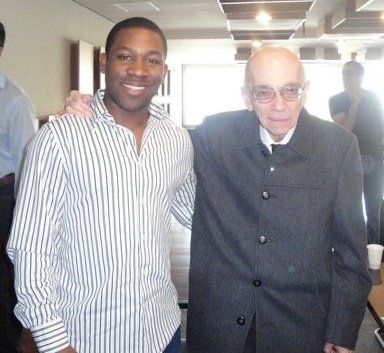
After the rehearsal we got to meet Maestro Abbado. Here I am with Lorrie, Katie, Abbado and Jonathan.


On Sunday morning we got to meet with Maestro Jose Antonio Abreu, founder of El Sistema, for about 2 hours.  In his talk with us three things really caught my attention. The first is that when he started El Sistema he insisted that human development be one of the key concepts of El Sistema. Not music, but human development. To help make his point he made sure that the government funding supporting El Sistema came not from the Ministry of Culture but from the Ministry of Social Welfare. In this way the government had to acknowledge that El Sistema was a social transformation program first and a music program second.

Second he encouraged us to put faith in our teachers, especially the younger ones. The teachers, says Maestro Abreu, will be the heart and soul of our programs. I know from our studies that I can look forward to seeing many, many young students in teaching positions throughout our stay in Venezuela.

And the third is something that will stick with me forever: "Culture for the poor should not be poor culture." This is happening here in Caracas. The diversity of the crowd at the Friday night concert with Dudamel was like nothing I've ever seen before back home. Whites, Blacks,  10 year olds (on the edge of their seats!), and senior citizens sitting side-by-side watching a very well-played Mahler symphony, at a fabulous hall with a world-class conductor.

Maestro Abreu is an incredible leader. He has complete command of his talking points, his arguments and their explanations. Even though he spoke off the cuff with us it was always eloquent and poetic.

Our meeting started as a simple meet and greet. He began speaking casually, pleasantries and all, but then it somehow morphed into a rousing speech. After 45 minutes I was ready to run through a brick wall for him. He is an amazing orator and if you've ever seen him speak you know what I'm talking about.  


On Sunday afternoon we took a cable car up to the top of El Avila (2175 meters), which towers above Caracas. From the top the views were stunning. One side of the mountain looks down over Caracas and the other, which is the picture below, looks down over villages and the Caribbean Sea. In the picture between Stan and I is Adam Johnston, son of author Tricia Tunstall, who you may remember is writing the very first book on El Sistema.


This man is known as "Antonin, the poet of Avila."  He was selling a poster of his own poem. They title is "Como Cambiar El Mundo" or "How To Change The World". Being the hopeless romantic I am, I had to buy a copy from him.


I have no idea what the body of the poem says, and I will translate it eventually, but with a title like "Como Cambiar El Mundo," I wouldn't be surprised if El Sistema was in there somewhere.

In the next few days we will be visiting Montalban, the flagship nucleo of El Sistema. Following this we will be split up into groups of two and three to visit nucleos throughout the country. Teaching and performing will be part of our residency, as well as research and documentation. My group is heading to the Andes to visit nucleos in Merida, Trujillo and Tachira.

Stay tuned for more!

Saturday, October 10, 2009

What are you doing in Boston?!!!

So that is the question I have had trouble answering in under 10 minutes all summer long! Here then is how I ended up in Beantown and what I'm doing here.

In May 2009 I was still considering pursuing a Doctor of Musical Arts in bassoon performance at a couple of schools in the USA. I just wasn't sure if I could get enough funds to do it. So I waited.

I was hanging out in my hometown (Ottawa) doing...well...nothing, when I got an email from Sue Heineman, the principal bassoonist of the National Symphony Orchestra in Washington D.C. It was about the Abreu Fellows Program at the New England Conservatory. I had been looking for this kind of program for a while. In fact, in all my doctorate application essays I had mentioned the Venezuelan youth education program El Sistema, saying it would be great to have something similar in the USA and Canada (I am Canadian). So here I was, looking at a brand new program that did exactly that. I couldn't believe my luck. From the El Sistema USA website:

"… the first initiative of el Sistema USA — a one-year postgraduate certificate program for accomplished young musicians who desire to become ambassadors of El Sistema and who are committed to developing it outside of Venezuela. Housed at New England Conservatory, Abreu Fellows will spend a year studying between Boston and Caracas, and leave with the tools to return to their communities to teach the El Sistema model."

That was good enough for me. And so, here I am in Boston.

What is El Sistema? Started in 1975 by Jose Antonio Abreu, it is the common name given to the National System of Youth and Children's Orchestras of Venezuela. Government funded and using the symphony orchestra as their vehicle, they provide music education to kids of all backgrounds all over the country.

Watch this great video explaining how El Sistema got to Boston:


And now the why. Why I am I doing this program? I lock myself in a room for hours on end to be a bassoonist right? Well yes, that's true...but

Two reasons in particular made this program worth it for me: under-served youths and symphony orchestras. I've seen many concerts in North America with great orchestras, conductors and soloists but unfortunately there are often empty seats. It's become obvious to me, as I'm sure it has to many others, that more could be done to draw a more diverse and younger audience. How to do that?

Well how about we invest in our youth. Let's make music education accesible to all youths no matter where they're from. Let's make music education a right, not a privilege. This way youths can reap the benefits of music and hopefully when they're older they will become concert-goers, musicians, stage-hands, arts administrators, patrons and aficionados.

Through this program I was offered the chance to hopefully make a positive difference for under-served youths and symphony orchestras. It was difficult to turn down.

Now it's not all doom and gloom for the orchestra world! Besides the fact that symphony orchestras deliver a fantastic product, the El Sistema phenomenon has caught on all over the world and youth orchestra programs often targeting under-served communities are already up and running in Los Angeles, Miami, Baltimore, New York City, Ottawa and more. I simply hope to help continue the trend.

To see the possibilities watch the top youth orchestra in Venezuela perform Leonard Bernstein's Mambo, led by Gustavo Dudamel, an El Sistema graduate and the new conductor of the Los Angeles Philharmonic:


Not too shabby eh/huh?

I'll be blogging about my experiences all year, so please come back and feel free to participate by leaving comments and/or questions. I feel that this type of project benefits us all, so don't be shy!

Imagine a world with millions of kids playing music...

Thanks for reading.