In the days prior to arriving in Caracas chaos reigned in my life: too many things to do before leaving and not enough time to do them all. People often asked me if I was excited about getting here and I had to tell that I didn't really know how I felt because I hadn't had time to think about it.
With everything that has been thrown at us this year, the residency in Venezuela seemed very far away to me. My thoughts were consumed with things like budgets, YouTube videos, first-hand testimonies, management skills, Abreu, fundraising, El Sistema, Spanish. I never had time think much about what Venezuela would be like. On top of that I didn't know what to expect. Travelling so far away seemed vague to me. I hadn't left North America in 12 years or so, the last time being when my high school orchestra travelled to Cuba to do an exchange with the Havana Conservatory orchestra.
As I write this, I realize that's it's kind of interesting that the only other time I've been to a Latin American country was to do something music-related. I am consistently amazed at how music has and keeps opening doors for me to experience different cultures, meet different people and learn new things. I believe that with music I can sit down with someone from anywhere in the world and connect with them without saying a word. I know our time here in Venezuela will prove me right.
It wasn't until the plane landed and the flight attendant announced "ladies and gentlemen welcome to Caracas" that I actually started getting really excited. I immediately went shutter-happy and to the dismay of my colleagues began snapping away pictures to no avail. Our first days here have been mostly an introduction to El Sistema and since I'm overjoyed to be here and taking way too many pictures, I figured why not show what we've been up to.
Upon our arrival at the airport in Caracas we were greeted by El Sistema staff, which included Roberto Zambrano, the director of the El Sistema program in Acarigua. You may remember him from by blog #3 as he was the one who gave us the El Sistema "Tocar Y Luchar" medallions.

Here I am at the airport with Rodrigo, our guide/host here in Caracas. Rodrigo works in El Sistema's office of International Affairs. He is a marvellous host with impeccable English and an encyclopedic knowledge of El Sistema's history and development. I was thrilled to see that when he greeted us at the airport he was wearing a Leading Note Foundation (Ottawa's own El Sistema-like program) T-Shirt.

Meet 19 year-old oboist Carmello. He hails from Chacao, a municipal area in Caracas. Rodrigo was leading us on a tour of El Sistema's stunning new performance and rehearsal center named "The Center For Social Action Through Music." Carmello's El Sistema nucleo is in Chacao but I imagine he was at the center to get in a bit of practice before going to attend the Simon Bolivar Youth Orchestra Concert, which was also taking place at the Center.

Here are all the fellows plus Rodrigo and Stephanie on the far left on a terrace of The Center For Social Action Through Music. This building is beautiful, with several terraces, which are accessible directly from the hallways. Every room in the building is multi-purpose and was built with acoustics in mind. They can all be used for rehearsals, performance or recording of any type of ensemble. The rooms are all equipped with multi-media outlets so performances can be broadcast via radio, TV and internet. Furthermore, the rooms all have floating floors which helps to minimize sound transference from room to room. There is minimal office space and at a whim, any office space can be turned into a performance space. What I admire most about this building, besides its great architecture is that it caters to music-making first and foremost. And from what I understand this was intentional, as this center's focus is to give the students the very best conditions in which to develop.

The same night of our tour we were invited to watch a concert celebrating the 35th anniversary of El Sistema. The program consisted of Gustavo Dudamel conducting the Simon Bolivar Youth Orchestra "A" (which contains the founding members of this orchestra), in Mahler's 9th Symphony. In this picture Dudamel takes a bow with the orchestra at the end of show. I have to point out that Dudamel is one of the only big-time conductors I know of that refuses to stand on the podium when he takes his bows with the orchestra. As you can see in this picture he's on the floor with the orchestra members. I've noticed this sense of togetherness and humility in every El Sistema student I've come across, from Boston to Caracas. Here, playing in the orchestra is as much about being a family as it is being musicians and this is easily recognizable when they play.

Backstage with Gustavo after the concert.

On Saturday morning we attended a concert at the Center given by the Teresa Carreno Youth Symphony, which is an orchestra of mostly high school students from Caracas. These are some kids lining up for the concert. This here is the future of instrumental music. These are the people that must be attending concerts.

In the picture below, on the left is Lila, the concertmistress of the Teresa Carreno Youth Symphony. She played her solos beautifully in Camille Saint-Saens' Danse Macabre. On the right is Daniel Arias who performed Saint-Saens' concerto for cello #1 brilliantly. I played both of these pieces in high school so this concert brought back some good memories.
I'm not sure if it's simply the size of the orchestras in El Sistema but they have a way of really drawing in the listener, especially the string sections which seem to all be playing for their life. It's not always perfect, no orchestra is all the time anyway, but it's intoxicating and mesmerizing. And just for your reference, this orchestra is the same one that performs in Jose Antonio Abreu's TED Prize talk, which I put in my blog #1. Believe me, this orchestra is even better live.

Before coming to Venezuela I collected bassoon related materials to give out to El Sistema programs. While Caracas has a healthy supply of these materials, a lot of the nucleos in the country and the mountains are lacking key materials. Remember that there are 184 nucleos in El Sistema and they don't all have access to the materials and teachers that a big city such as Caracas does.
Robert Zambrano's nucleo in Acarigua is one of these nucleos in need, especially for bassoon and oboe materials. Here we are at the Center with his nephew, Aquarius Zambrano. These materials, which include reed cases, cane and reed knives were graciously donated by Matthew Ruggiero, a long-time Bassoonist with the Boston Symphony Orchestra and Sue Heineman, Principal Bassoon of the National Symphony Orchestra. Thank you both for your generosity.

On Saturday afternoon we attended a rehearsal of the Simon Bolivar Youth Orchestra "B" conducted by Claudio Abbado. This is the orchestra that you see on YouTube all the time and tours the world with Gustavo Dudamel. Here is a picture of the bass section.
In seeing them in person for the first time one thing that caught my attention was how much they moved as a group when they played. I've never seen a bass section move like that. That night we had dinner with Alejandro, the concertmaster of the orchestra, and his wife, and I spoke to Alejandro about my observation. He chuckled and said that what I had seen in rehearsal was nothing. "Just wait until the concert." Well I can't wait to see this. The concert, conducted by Claudio Abbado, is Wednesday and it includes Berg's Lulu, Prokofiev's Symphonic Suite and Tchaikovsky's Symphony #6.

After the rehearsal we got to meet Maestro Abbado. Here I am with Lorrie, Katie, Abbado and Jonathan.

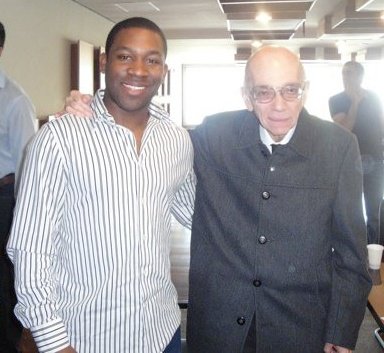
On Sunday morning we got to meet with Maestro Jose Antonio Abreu, founder of El Sistema, for about 2 hours. In his talk with us three things really caught my attention. The first is that when he started El Sistema he insisted that human development be one of the key concepts of El Sistema. Not music, but human development. To help make his point he made sure that the government funding supporting El Sistema came not from the Ministry of Culture but from the Ministry of Social Welfare. In this way the government had to acknowledge that El Sistema was a social transformation program first and a music program second.
Second he encouraged us to put faith in our teachers, especially the younger ones. The teachers, says Maestro Abreu, will be the heart and soul of our programs. I know from our studies that I can look forward to seeing many, many young students in teaching positions throughout our stay in Venezuela.
And the third is something that will stick with me forever: "Culture for the poor should not be poor culture." This is happening here in Caracas. The diversity of the crowd at the Friday night concert with Dudamel was like nothing I've ever seen before back home. Whites, Blacks, 10 year olds (on the edge of their seats!), and senior citizens sitting side-by-side watching a very well-played Mahler symphony, at a fabulous hall with a world-class conductor.
Maestro Abreu is an incredible leader. He has complete command of his talking points, his arguments and their explanations. Even though he spoke off the cuff with us it was always eloquent and poetic.
Our meeting started as a simple meet and greet. He began speaking casually, pleasantries and all, but then it somehow morphed into a rousing speech. After 45 minutes I was ready to run through a brick wall for him. He is an amazing orator and if you've ever seen him speak you know what I'm talking about.

On Sunday afternoon we took a cable car up to the top of El Avila (2175 meters), which towers above Caracas. From the top the views were stunning. One side of the mountain looks down over Caracas and the other, which is the picture below, looks down over villages and the Caribbean Sea. In the picture between Stan and I is Adam Johnston, son of author Tricia Tunstall, who you may remember is writing the very first book on El Sistema.

This man is known as "Antonin, the poet of Avila." He was selling a poster of his own poem. They title is "Como Cambiar El Mundo" or "How To Change The World". Being the hopeless romantic I am, I had to buy a copy from him.

I have no idea what the body of the poem says, and I will translate it eventually, but with a title like "Como Cambiar El Mundo," I wouldn't be surprised if El Sistema was in there somewhere.
In the next few days we will be visiting Montalban, the flagship nucleo of El Sistema. Following this we will be split up into groups of two and three to visit nucleos throughout the country. Teaching and performing will be part of our residency, as well as research and documentation. My group is heading to the Andes to visit nucleos in Merida, Trujillo and Tachira.
Stay tuned for more!

